
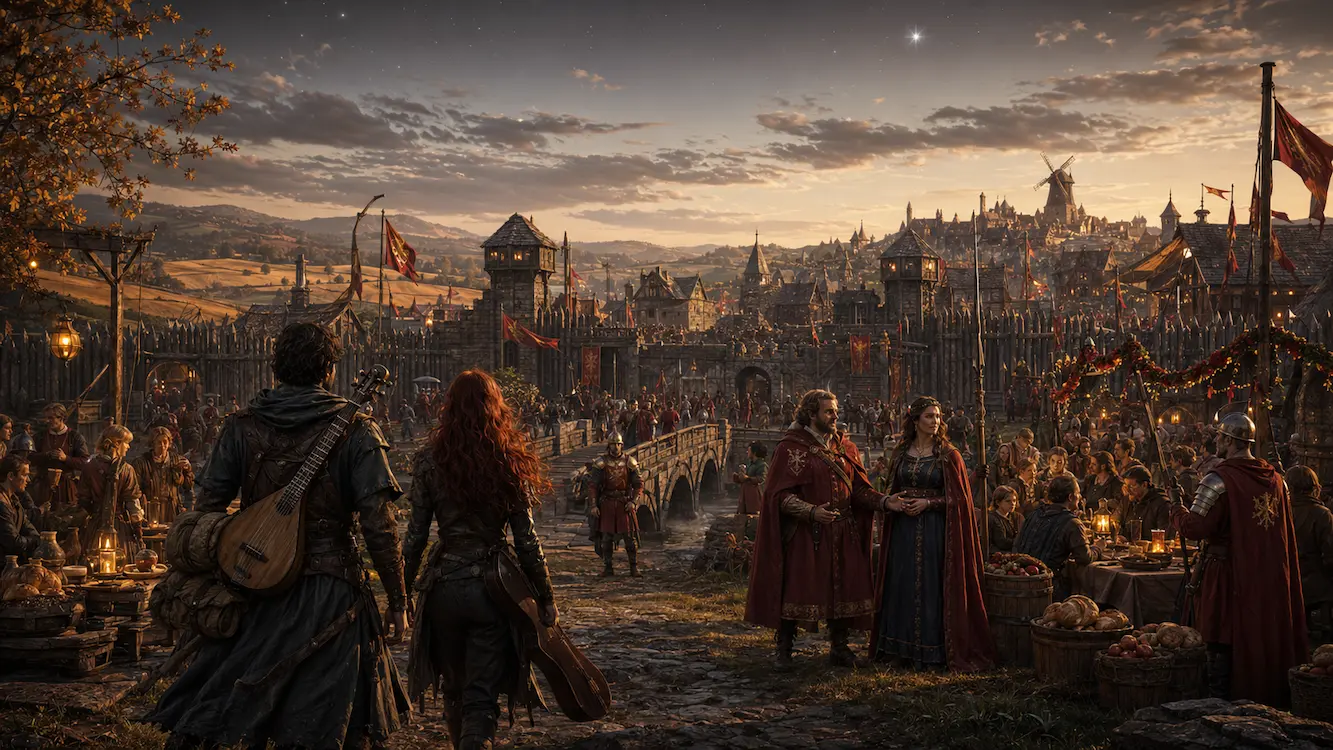
Ironhaven smelled of wheat, horse sweat, hot bread, and steel.
That is how I remember it.
Not the banners. Not the walls. Not even the king.
The smell comes first.
We reached the outer farms of Ironhaven three days before the harvest feast at Lark’s Gate. Edda and I had walked since dawn, following a stone road that ran straight through fields of barley and goldgrass. The road was old, but well kept. The stones sat flat. The ditches were clear. Milestones stood every league, each one carved with Alaric’s lion and the words:
ORDER HOLDS THE REALM.
Edda read the words aloud and snorted.
“Sheep like that sort of thing.”
“Milestones?” I asked.
“Orders.”
“Sheep also like grass. That does not make grass wicked.”
She looked at the next milestone as we passed it. “No. But I still do not trust anything that has to be carved into stone every mile.”
That was Edda. She could argue with a signpost and come away believing she had won.
We had been hired for the feast by a miller’s wife named Hesta, who had sent word along the road that Lark’s Gate needed music. Her daughter was to be married on the same day the village brought in the first harvest wagons. A wedding and a feast together meant food, coin, and people in generous moods.
Those are the three pillars of a musician’s faith.
By midday we could see Lark’s Gate ahead. It was not a city, though city folk liked to call every place smaller than their own a village. Lark’s Gate was a strong market town with a wooden palisade, two watchtowers, a stone bridge, and enough pride to make up for any lack of size. Farms spread around it in neat strips. Cattle grazed along the low hills. Children chased one another near the road until a woman shouted them back from the wheels of a passing cart.
Ironhaven was built by people who liked lines.
Straight roads. Square fields. Trimmed hedges. Stone walls. Ranks of soldiers. Ledgers balanced to the copper.
Even their scarecrows looked disciplined.
A patrol stopped us before the bridge. Six soldiers in red and gold stood across the road, shields resting against their legs. They were not old, but they stood like men who had been corrected often and recently.
The sergeant looked at my lute, then at Edda’s fiddle case.
“Names.”
“Simon of the Road,” I said. “This is Edda.”
“Of where?”
“The road.”
His face did not move. “That is not a place.”
“It is if you sleep on it often enough.”
Edda elbowed me.
The sergeant turned to her. “Purpose in Lark’s Gate?”
“Music,” she said. “Unless your town dances in silence.”
One of the younger soldiers almost smiled.
The sergeant did not.
“Feast players?”
“Yes,” I said. “Hired by Hesta of the mill.”
He checked a wax tablet. Ironhaven soldiers loved tablets.
“You are late.”
“We were waylaid by rain.”
“It has not rained in five days.”
“Dust, then.”
Edda sighed. “We are musicians. We are late by nature.”
The sergeant considered this, then waved us through.
“Keep your knives tied. No playing after the second bell unless the watch captain allows it. No songs mocking the king, the crown, the army, the tax scales, or the western grain measure.”
I blinked. “There is a song mocking the western grain measure?”
“There was.”
“What happened to it?”
“The man now sings in another town.”
Edda leaned close as we passed. “I like this place already.”
“You like places where someone else gets in trouble.”
“I like efficient warnings.”
Inside the palisade, Lark’s Gate was alive with feast work. Long tables were being dragged into the square. Garlands hung from beams and wells. Boys carried barrels. Girls carried baskets of apples. Old men argued over where to set the roasting pits and then moved nothing. Every window had cloth tied from it. Red and gold strips fluttered beside wedding ribbons of blue and white.
The bride’s family had taken over the mill yard. Hesta found us before we found her. She was broad-shouldered, grey-haired, and had the look of a woman who could lift a grain sack, deliver a child, and end a tavern fight with the same expression.
“You’re Simon?”
“I am.”
“You’re thinner than I expected.”
“I am often better heard than seen.”
She looked at Edda. “And you’re the fiddler.”
“Depends who is asking.”
“I am asking, and I am paying.”
“Then yes.”
Hesta grunted. “Good. You’ll play after the first blessing, again when the wagons come in, and again after the meal. No sad songs until the old people are drunk enough to enjoy them. No songs about dead brides. No songs about false grooms. No songs about the moon stealing maidens. My sister cried for two hours last time.”
“That is a lot of rules for joy,” Edda said.
“It is a wedding,” Hesta replied. “Joy must be managed or it bites someone.”
I liked her immediately.
She gave us a corner of the mill loft to set our packs and sent a boy to fetch water. From the loft window I could see the town square and the training yard beyond it. Soldiers drilled there with wooden swords under the eye of a captain with a scar running from ear to chin. They moved in pairs. Strike. Block. Step. Turn. Strike again.
One young soldier lunged too far and lost his footing. His partner tapped him on the ribs with a wooden blade.
“Dead,” the captain called.
The young soldier flushed.
The captain pointed. “Again.”
They reset.
He lunged again. Better this time, but still too eager. His partner caught him on the shoulder.
“Dead.”
The young soldier threw his arms down. “I had him.”
“You had an idea,” the captain said. “He had your shoulder. Again.”
Edda watched beside me.
“Poor boy,” she said.
“He will learn.”
“Or he will collect bruises until he becomes philosophical.”
The young soldier reset a third time.
Before he could move, a voice spoke from the edge of the yard.
“Not like that.”
The yard went still.
King Alaric Stormforge walked through the gate with no herald before him.
That was the first time I saw him.
He was not dressed like a storybook king. No gold crown. No velvet cloak. No jewels. He wore a plain red riding coat, leather gloves, and a sword at his hip. He was tall, though not in the way that makes other men look small. His beard was trimmed short. His hair had iron in it. His eyes were grey and direct.
The soldiers straightened as if pulled by strings.
Alaric waved them down and stepped into the yard.
“Show me,” he said to the young soldier.
The boy looked ready to faint. “Your Majesty?”
“Show me the strike.”
The boy did.
Alaric caught the wooden blade with his own hand before it reached him. Not hard. Not cruel. Just certain.
“You are trying to win with the first blow,” he said.
The boy swallowed. “Yes, Majesty.”
“Why?”
“To end the fight.”
“To end your fear of the fight,” Alaric said. “That is different.”
No one spoke.
Alaric took a wooden sword from the captain and placed it in the boy’s hand again.
“Your first strike failed. Good. Now you know something. A failed strike is not the end unless you let it be.”
He stepped back.
“Again.”
The boy attacked. Alaric moved aside, let the strike pass, and tapped the boy’s wrist.
“Again.”
The boy tried once more.
“Again.”
On the fourth attempt, Alaric nodded.
“There. You felt the correction before you made the mistake.”
The boy stared at his own hands as if they had become wiser.
Alaric returned the wooden sword to the captain.
“Drill them in pairs until sundown. No man learns courage by being told he has it.”
Then the king turned and looked up at the mill loft.
At me.
At Edda.
I had not thought we were visible from the yard.
Edda lifted two fingers in a lazy salute.
The captain looked horrified.
Alaric smiled.
It was a small smile. Tired, maybe. But real.
That is the part I remember when men ask whether Alaric was always a monster.
No.
He smiled at a rude fiddler in a mill loft. He corrected a frightened soldier without shaming him. He walked through a town without trumpets because he wanted to see if the feast preparations were going well.
That is what makes the rest harder to sing.
A villain born wicked is a simple tune. It has three chords and no surprises.
A good man turning is harder.
The feast began before dusk.
The whole town gathered in the square. The bride was named Sella, the groom Maron. She had flowers in her hair and flour on one sleeve. He had polished his boots so fiercely that they looked frightened. They stood before a travelling priest of the Concord while Hesta wept into a cloth and denied doing it.
Edda played first. A clean, bright line from her fiddle cut through the square. People turned. Children stopped fidgeting. Even the soldiers along the palisade looked down from their posts.
Then I joined her with the lute.
We played the old wedding walk, the one everyone knows but no one admits to liking until they start humming. Sella and Maron made their vows. They promised bread, shelter, patience, truth, and shared labour. Sensible vows. Human vows. The kind that matter after beauty fades and winter comes.
When the priest spoke the blessing, the whole square repeated the last line:
“May the road home remain open.”
It was a common Ironhaven blessing.
It hurts me now.
After the vows, the first harvest wagons rolled in through the eastern gate. Barley sacks were stacked in the square. Apples were poured into baskets. Children cheered when the first cask was opened. Someone handed me a cup before I had earned it, which is proof that civilisation had not yet collapsed.
King Alaric sat at one of the long tables, not on a raised platform.
Queen Lyra sat beside him.
She was easier to miss and harder to ignore.
Alaric drew the eye first. He was the shield on the wall, the sword at the gate. Lyra was the hand moving pieces on a board no one else had noticed.
She wore a dark blue gown under a red cloak, with no crown, only a thin circlet of iron. Her hair was black and braided simply. While Alaric spoke with farmers and soldiers, Lyra watched everyone.
Not coldly.
Not suspiciously.
Carefully.
There is a difference.
A merchant from the south approached with three men behind him. He bowed too low, which is how you know a man thinks respect is a price he can pay cheaply.
“Your Majesties,” he said. “A blessing on Ironhaven’s harvest. I bring news from the lower crossings.”
Lyra held out one hand. “Written?”
The merchant produced a sealed packet.
She broke the wax, read the first sheet, then the second. Her face did not change.
Alaric leaned toward her. “Trouble?”
“Claimed trouble,” she said.
The merchant smiled nervously. “Bandits, Majesty. Northern blood. Wild men out of the cliffs. They struck two caravans and took iron, grain, and three horses.”
“Did they kill anyone?” Alaric asked.
“One guard was injured.”
“Did they take coin?”
The merchant paused. “No.”
“Wine?”
“No.”
“Silks?”
“No.”
Lyra looked up from the packet. “So these bandits took grain, iron, and horses, but no coin or luxury goods.”
“They are savages, Your Majesty. Who knows why they do anything?”
Edda, standing beside me with her fiddle under one arm, muttered, “Hungry savages with practical needs, apparently.”
I covered it with a cough.
Lyra heard. Of course she did.
The queen’s eyes flicked to us, then back to the merchant.
“Your third page says the caravan crossed north of its permitted route to avoid a bridge tax.”
The merchant’s smile weakened.
Alaric looked at him.
The air around the table changed.
“It was a small matter,” the merchant said.
“Taxes maintain bridges,” Alaric said.
“Yes, Majesty.”
“Bridges maintain roads.”
“Yes, Majesty.”
“Roads maintain the realm.”
The merchant bowed again. “Of course, Majesty.”
Alaric’s voice remained calm. “Your claim will be reviewed. If northern clans attacked lawful trade, I will answer it. If you trespassed through clan-held winter ground to avoid crown tax, you will pay double.”
The merchant opened his mouth, then wisely closed it.
Lyra folded the packet.
“Enjoy the feast,” she said.
The merchant left looking less hungry than when he arrived.
Edda watched him go. “I like her.”
“That is because she just cut a man without drawing blood.”
“Clean work should be admired.”
A bell rang from the watchtower before I could answer.
Not an alarm.
A signal.
The gate opened, and a rider entered at speed.
The square turned.
The horse was lathered. The rider wore the dust of long travel and the green sash of a Concord messenger. He dismounted too quickly and stumbled. Two soldiers caught him.
Alaric stood.
The messenger dropped to one knee.
“From the Sacred Grotto,” he said.
The feast quieted so fast I heard the roasting fat hiss in the nearest fire.
Alaric took the sealed scroll.
The wax bore the mark of the Grotto: five lines meeting at a circle.
Lyra stood beside him now.
Alaric broke the seal and read.
The square waited.
I have played to crowds of drunk soldiers, grieving widows, bored nobles, and children with sticky hands. I know the sound of people waiting.
This was different.
This was a whole town holding its breath.
Alaric lowered the scroll.
“The five crowns have been called to council,” he said.
Murmurs ran through the square.
“At the Sacred Grotto,” he continued. “There are omens in the realm. The Concord asks all kings to attend before the harvest moon.”
A farmer near the front called out, “War, Majesty?”
Alaric did not answer too quickly. That was one of the reasons people trusted him.
“No,” he said at last. “Not war.”
The square eased.
Then Lyra spoke softly, but I was close enough to hear.
“Not yet.”
Alaric looked at her.
She did not take it back.
The feast resumed, because people do that. Give them warning of doom and enough ale, and they will still ask who wants more bread.
Music helps.
So Edda and I played.
We played quick dances first. Ironhaven liked stomping songs, strong rhythms, anything that let boots hit wood in unison. Farmers danced with soldiers. Children spun until they fell. Hesta dragged her new son-in-law into a reel and nearly killed him with joy.
Alaric danced once with the bride, once with Hesta, and once with an old woman who scolded him for growing too thin. He accepted all three with good humour.
Lyra did not dance.
She sat with the Grotto scroll in front of her and read it again between conversations. Once, I saw her take a small card from within her sleeve, glance at it, and burn it in the candle flame. Then she wrote a note on the back of the scroll.
Edda saw it too.
“What was that?”
“A queen making a choice.”
“What choice?”
“If I knew that, I would be sitting at the table and you would be playing alone.”
She gave me a look. “Do not dream too high. You would last half a day at court.”
“Half a day at court is longer than I want.”
Later, after the second bell, when the children had been carried home and the old people had reached the stage where sad songs became welcome, Hesta gave us permission to wound the crowd.
Edda began with a low tune. Slow bow. Open strings. A sound like wind moving through an empty house.
I sang The Lone Warrior of Keth’s Ford.
It is an old Ironhaven song about a soldier who holds a bridge alone while his village escapes. In the song, he dies after killing twelve enemies. In most towns, that line gets cheers.
In Lark’s Gate, no one cheered.
They listened.
Alaric listened hardest.
When I finished, the square was quiet.
Then one old man near the fire lifted his cup.
“To those who stand.”
The whole square answered.
“To those who stand.”
That was Ironhaven at its best.
Not gentle. Not soft. Not free of pride. But loyal. Steady. Ready to stand between danger and home.
Remember that when you hear what came later.
Near midnight, I stepped away from the noise to wet my throat at the well. My fingers ached. My back hurt. My purse had gained enough weight to improve my opinion of mankind.
Queen Lyra was there before me.
She stood beside the well with the Grotto scroll in one hand. No guards stood close, but I had no doubt they were near enough to kill me if I became interesting.
“Simon of the Road,” she said.
“Your Majesty.”
“You sing as if you have been hungry.”
“I have.”
“That is why you notice what full men miss.”
It was not a question, so I said nothing.
She looked toward the square. Alaric was speaking with the watch captain. His shoulders were straight. His face was calm. Men leaned toward him when he spoke.
“He is a good king,” Lyra said.
“Yes.”
“You say that like a man who is surprised.”
“I have met kings.”
That earned the smallest smile.
“He believes order can save people,” she said.
“That seems a useful belief for a king.”
“It is.” She folded the scroll. “Until order becomes the thing being saved.”
I looked at her then.
The feast noise filled the space between us. Fiddle. Drum. Laughter. Someone breaking a cup. Hesta shouting that whoever broke it had bought it.
Lyra’s face remained still, but her hand tightened around the scroll.
“What has happened at the Grotto?” I asked.
“I do not know.”
“Queens often say that when they know too much.”
“And bards often say clever things when they know nothing.”
“True.”
She turned to me fully. “You are going to the Grotto.”
It was not a question.
“Am I?”
“The Concord has called the kings. Every court will bring guards, scribes, priests, merchants, servants, spies, and fools. There will be coin for music.”
“You wound me, Majesty. I am at least two of those things.”
“Be whichever keeps you alive.”
The way she said it made my mouth go dry.
“Do you expect danger?”
“I expect kings,” she said.
Then she placed a small silver piece on the well stones. Too much for a song. Not enough for a bribe.
“What is this for?” I asked.
“For listening.”
“To what?”
“Everything.”
She left before I could answer.
Edda found me a moment later.
“You look like someone just handed you a prophecy.”
“A queen handed me a coin.”
“Worse.”
I showed it to her.
She took it, bit it, and handed it back. “Real.”
“You could ask.”
“I did ask. With my teeth.”
I looked toward the square. “The kings are going to the Grotto.”
“I heard.”
“There will be work there.”
“There will be trouble there.”
“Likely.”
She leaned against the well. “We are still going, aren’t we?”
“Where kings gather, musicians eat.”
“That is your worst wisdom.”
“It has kept us alive.”
“It has kept us moving. Different thing.”
Above us, the sky was clear. Stars hung bright over Lark’s Gate. One star in the north seemed larger than the rest.
I noticed it because it did not flicker.
At the time, I thought nothing of it.
That is the cruelty of omens. They only become obvious after they have finished with you.
A shout rose from the square. Hesta was calling for one more dance. Edda pushed away from the well and tucked her fiddle under her chin.
“No sad songs,” she said.
“At a wedding?”
“At a warning.”
She played before I could answer, a fierce quick tune that pulled people from benches and back into the open space. Boots struck the ground. Hands clapped. The bride laughed. The groom nearly fell. Alaric smiled again, though Lyra did not.
For a little while longer, Ironhaven held.
For a little while longer, the roads were open, the king was good, the banners were only cloth, and the star in the north was only a light in the sky.
I have lived long enough to know that most endings begin that way.
Not with screams.
Not with fire.
With music.
With bread.
With a good king smiling at his people while doom waits patiently above him.