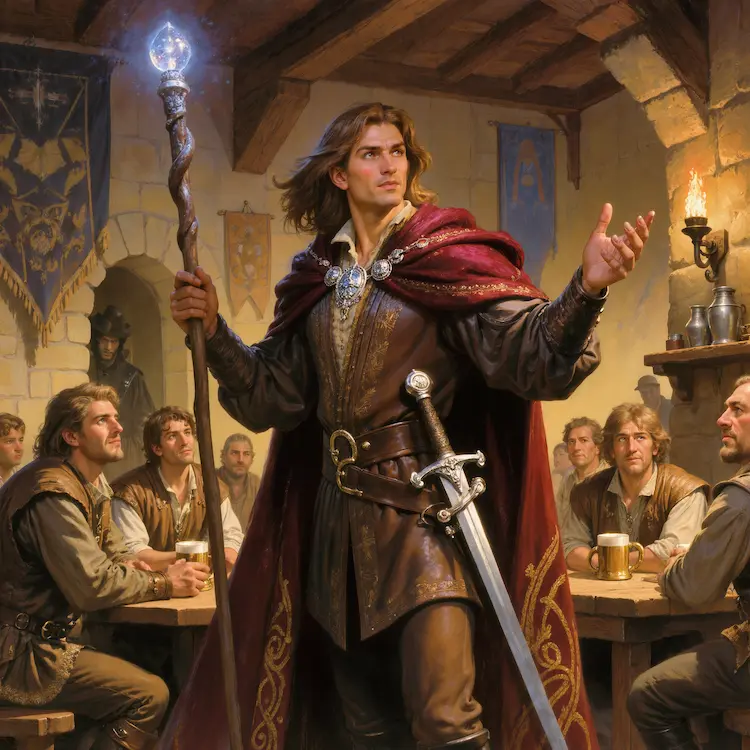
Heroes and Spells

The Lore of Thaloria
As recalled by Simon of the Road, sometime-bard, witness to the fall of the Gentle Age, and last singer of a world that refused to die.

Welcome to Thaloria, a realm once bound by peace, honour, magic, craft, and ancient friendship. This is the story behind Heroes and Spells: the fall of five kingdoms, the corruption of their rulers, and the rebellion that rose from the ashes.

Part I — The Golden Age

I have played in royal courts and smoky cookhouses, upon market stones, beside campfires, and under trees old enough to remember the first names of the stars. Wherever I set down my battered lute, I begin with one name, spoken softly enough to steady the listener’s heart.

Thaloria.

Say it gently, and you may hear the hush of starlit pools. Speak it boldly, and you may feel the lift of mountain winds beneath your ribs. In my youth, when my fingers were quick, my boots were dusty, and bread still tasted like joy, I crossed that realm with music on my lips and wonder in my bones.

And I tell you true: the world was whole then.

The five kingdoms stood as fingers on a hand, different in shape and strength, yet joined by a single living heart.

To the north stood Ironhaven, where stone has its own honesty and iron rings like a promise kept. The people there hammered their days into shape with patient blows: smith to anvil, baker to kneading board, child to a mother’s steady heartbeat. Their king, Alaric Stormforge, ruled not through fear or flame, but through fairness. He was a man of calm eyes and strong hands, and it was said he walked the forges each morning to feel the heat that warmed his people’s bread.

I remember seeing him once, years ago, when I played at a wedding in a town called Lark’s Gate, a poor name for a place that smelled of apples, rain, and hot iron. The king passed through that day, unguarded save for one weary knight. He stopped to bless the couple with words as plain and true as the land itself. When he left, the old man who had hired me pressed a coin into my palm and said, “Sing something that remembers us.”

I laughed then.

Why would anyone need a song to remember a world so solid?

Far south lay Mistwild, where you do not so much enter the forest as allow the forest to notice you. The air hums with meanings no tongue can fully hold, and twilight teaches even proud men to whisper. The elves built their homes as if asking the trees’ consent: wood and crystal, leaf and light, shaped together in quiet harmony. In the central glade stood Evermist, the sacred silver tree, its branches raised like prayers to the moon.

There I once met King Thalorien, tall, grave, and kind-eyed, walking alone upon a fern-soft path. He raised one hand in greeting as he passed, and I confess the honour of being noticed warmed me for days.

To the west rose Runegrim, where the mountains crouch like old gods. The dwarves call their halls cities, but the word fits them like a child’s coat, far too small for their grandeur. Runegrim’s halls were cathedrals of fire and craft, vaults ribbed with iron, where the clang of purpose rang like a holy liturgy. King Haldrek Flamebeard once paid me for carrying a sealed letter with an iron token stamped hammer-and-star.

“Spend it unwisely,” he boomed, which in the dwarven tongue means something close to, enjoy yourself properly, or I shall be insulted.

I bought a traveller’s blade with that coin, plain and strong. The smith wrapped it as though laying a child to rest. A line of runes still rests along its guard, watching over the fool who carries it.

In the east, the ground breaks into Shadowspire, a land of glass, ash, and edges sharp enough to cut the dawn. Obsidian towers catch sunrise like captured fire, and rivers of magma draw glowing roads through the dark. Goblins thrive on edges. They are a people bruised by the world, yet full of fierce laughter. Their Wizard King, Zarkul Grimhex, I saw once upon a flight of black stairs, taller than most of his kind, crimson eyes half-hidden like coals beneath ash. Cleverness lived in him, and an iron will no blade could cut. Children spoke his name with a shiver that was fear and thrill knotted together.

And far to the southeast, where the mists never quite lift and the air tastes faintly of peat, rain, and endings, lies Cryptgard. Few have walked its causeways in living memory, and fewer still speak plainly of what they saw. Some say it was once a land of scholars and sorcery, where the living studied death until they began to resemble it. Others claim it was never truly alive, only a reflection of the world’s forgotten fears.

Travellers skirt its borders, crossing themselves or muttering small prayers when the fog drifts too near. I once met a man in Ironhaven who swore he had seen Cryptgard’s spires by moonlight, pale towers leaning like weary sentries, their reflections trembling in black marshwater. He said he heard bells tolling beneath the earth, though no wind moved.

I laughed then, because in youth we believe laughter can keep fear away.

Now, when the nights are long and the fog creeps low, I do not laugh.

I listen.

They say Azmorth Grimshroud ruled there, a wizard-king who sought to master the veil between life and death. Some claim he succeeded. Perhaps that is why Cryptgard will not die properly. The mists remember him, even when men try not to.

The five realms were bound not only by trade and treaty, but by reverence for one sacred place: the Grotto at the heart of Thaloria.

I saw it with my own eyes before ruin took its peace. Imagine a valley held like a chalice between green hills, its rim set with standing stones worn smooth by centuries of prayerful hands. The pools mirrored the heavens so clearly that starlight seemed trapped beneath the water. At its centre stood a marble altar, pale and weathered, where generations of kings had met in concord.

There, under skies of peace, I once played my lute not for gold, but for wonder. The air was so still that every note lingered longer than it should, as though the valley itself wished to hum along.

It was said that the five kings met there each season: Alaric of Ironhaven, Thalorien of Mistwild, Haldrek of Runegrim, Zarkul of Shadowspire, and Azmorth of Cryptgard. They were as different as earth, leaf, flame, ash, and mist, yet bound by the fragile hope that reason might triumph over ambition.

I was present at one such gathering, or near enough to pretend I was more important than I had any right to be. The moon had just climbed, and the runestones glowed like warm embers. The kings argued, as kings always do, but laughter followed their quarrels. When the feasting began, I sang a foolish ballad about a miller’s daughter who married a river prince, and even Haldrek’s beard shook with laughter. Zarkul smiled once, small and sharp, like a blade catching light.

If I sound as though I loved that time, it is because I did.

The world was gentler then.

Or perhaps I was.

I believed such peace would never end. But peace is like a candle. It burns brightest just before the wind finds it.

The omens began quietly.

In Ironhaven, a scarecrow turned its head though there was no wind.

In Mistwild, a shadow hung beneath a tree where the leaves moved, but it did not.

In Runegrim, a forge-fire burned blue and spat a perfect hole through a newly forged shield.

In Shadowspire, a glassmaker swore that a flaw in his work moved each time he looked away.

And in Cryptgard, the mists began to deepen.

But we were too small, and the world too large, to notice its trembling.

The night the heavens split, I was camped with my dear friend Edda, a fiddler with hands like bird-bones and courage that made mine look thin. We were arguing about whether the moon favoured poets or thieves when the stars leaned in one direction, as though the sky itself had taken a breath.

The wind went still.

From the north, a white line tore across the dark, bright as creation and cruel as truth.

But it was not white. Not truly. It was every colour at once, clothed in fire that writhed like banners and trailing a darkness too deep to name. It screamed, not like a beast, but like something that remembered being whole.

Every living thing looked up.

Even the sheep in the fields lifted their heads as one.

Edda took my hand, and for once, she made no joke.

When the star fell, it struck the Sacred Grotto at the heart of Thaloria, and the ground leapt like a struck drum. The roar came after, rolling over hills, through villages, under doors, and into the bones of men. When silence returned, the world felt thinner, as though some great breath had been stolen and forgotten.

At dawn, we walked toward the light.

All roads in Thaloria lead to the Grotto eventually, though none who went that day would ever claim to have found it as it once was.

The grass had turned to gold — not gold in colour, but true metal, soft and gleaming beneath our feet. Trees stood coated in molten sheen, their bark hardened like armour. The pools reflected fire instead of stars. The altar was gone. In its place yawned a crater rimmed with black glass and stone fused by impossible heat.

The air smelled of iron and honey.

And we were not the first to arrive.

From every horizon, banners approached: Ironhaven’s silver lion, Mistwild’s crescent leaf, Runegrim’s hammer and star, Shadowspire’s black flame, and from the mists of the southeast, the pale sigil of Cryptgard.

Five kings gathered at the wound in the world.

I, Simon of the Road, stood among the crowd and watched the age I loved walk willingly into its ending.

Part II — The Omen and the Touch

The morning after the fall came pale and thin, a light that could not decide whether it belonged to dawn or smoke. We gathered along the edge of the crater, a thousand strangers bound by silence. No one spoke above a whisper, for to raise one’s voice there felt like breaking a vow.

The kings came one by one, their banners bending in the scorched wind.

King Alaric arrived first, his armour still dusted with forge soot, his eyes grim and searching. He knelt beside the crater as though before an anvil, murmuring words I could not hear. Behind him stood the men and women of Ironhaven, faces set, their faith placed wholly in their king’s steady hands.

From the south came Thalorien of Mistwild, ivy braided through his silver hair. The elves moved like ghosts through the shimmering heat. Their king paused before the glowing pit, and I saw his lips form a single word.

Sorrow.

Haldrek Flamebeard came next, his laughter dimmed but his stride unbroken. The dwarves carried their hammers as though for prayer, not war. They peered into the crater, craftsmen judging the work of gods and finding it wanting.

“Too hot,” one whispered. “No hand should touch that fire.”

Then Zarkul Grimhex appeared, tall among his warriors, his obsidian robes stirring like black water. He looked upon the crater with a hunger that frightened me. He did not see ruin there. He saw opportunity.

Last came Azmorth Grimshroud of Cryptgard, emerging from the mist as if the fog itself had taken form. His warriors marched behind him, few and silent, their armour bearing the dull sheen of moonlight on bone. He said nothing. He merely raised his hooded head toward the smouldering hollow and breathed in, slow and deep, like a man scenting rain after drought.

The five kings stood at the rim of the world’s wound.

For the first time in living memory, none of them spoke.

A shiver passed through the crowd, the kind that has nothing to do with cold. Edda gripped my arm hard enough to leave a bruise.

“Don’t look,” she whispered.

But of course, I did.

At the heart of the crater lay what had once been a star. It pulsed softly, breathing light like a heart that refused to die. Its surface was neither stone nor metal, but something between, shifting colours, rippling faintly, as though it watched us back. The air around it bent and shimmered. Shapes warped. Whispers stirred in a language older than sound.

Thalorien was first to move.

He stepped forward, long fingers trembling as he reached toward the glow. A hush swept the gathered host, broken only by the distant cry of a crow that must have lost its way. The elf-king paused as if listening to a voice no one else could hear, then stepped back, shaken.

“Alive,” he murmured. “The stone is alive.”

Haldrek snorted. “Then we should slay it before it wakes.”

Yet even he could not tear his gaze away.

Zarkul’s eyes burned brighter. “Alive or dead, what matters it? Power lives there. Do you not feel it?”

Alaric turned to him, his voice measured. “Power that does not belong to us should be left where it lies. Thaloria stands in peace. Let this be buried and forgotten.”

“Peace?” Zarkul laughed, a sharp sound that sliced the air. “Peace is a word the weak use when they have nothing worth taking.”

The crowd stirred. Even the soldiers of Ironhaven shifted uneasily. I remember thinking then that a single word, carelessly dropped, could split kingdoms as surely as the fallen star had split the earth.

It was Azmorth who ended the debate.

Without a word, he stepped forward, the hem of his robes dragging a thin trail of mist behind him. He raised both hands and whispered something too low for mortal hearing. The air changed. The light around the stone shuddered, dimmed, then flared so fiercely that we all cried out.

When the glare faded, Azmorth stood with his palm pressed against the heart of the fallen star.

The sound that followed was not a scream, not exactly. It was the echo of one, buried for centuries and freed at last.

The ground shook. The kings staggered.

And when Azmorth turned, his eyes had gone white — not the white of blindness, but the white of something that sees too much.

Thalorien rushed to pull him back, but the wizard-king only smiled.

“It speaks,” Azmorth said softly, his voice trembling with awe and terror. “It remembers us.”

Before any could stop him, Haldrek stepped forward, muttering oaths of the forge, and laid his own calloused hand upon the star. Fire leapt from the crater’s edge, blue and bright. The dwarves fell to their knees, shielding their faces. When it died, Haldrek’s beard smouldered like a wick, yet he laughed, deep and booming, until the stones trembled.

“I feel it!” he cried. “By the mountain’s heart, I feel it!”

One by one, the kings succumbed, drawn not by courage, but by compulsion.

Zarkul’s touch left cracks of obsidian where his fingers lay.

Thalorien’s skin shone faintly, as though his veins ran with starlight.

Even Alaric, steadfast Alaric, could not resist. He knelt, closed his fist around a fragment no larger than a coin, and when he rose, he did not let it go.

The sky groaned overhead. Clouds twisted into a spiral. The golden grass around the crater withered, blackened, then flared to ash.

Edda pulled me away.

We ran until the roar behind us became silence again.

That night, across Thaloria, the world began to change.

Forges burned without fuel. Leaves whispered names in languages no one knew. Rivers shimmered with veins of gold, and dreams carried voices that did not belong to those who dreamt them.

We thought it a wonder.

But it was a warning.

Part III — The Breaking of Kings

Sleep found me at last, though I did not invite it. The fire had burned low, and Edda’s fiddle lay silent beside her pack. The night was still. Too still. My eyelids closed as though pressed down by an unseen hand, and the dream took me whole.

The First Vision — Ironhaven

I stood in Ironhaven’s fields, only they were not fields anymore, but mirrors. Every blade of wheat was a sliver of gold catching the sun. The people sang praises as they reaped, laughter ringing like coin against stone.

Then they raised their scythes, and the crop bled molten metal.

Their hands blackened with smoke.

King Alaric rode through the golden mire, his armour gleaming like a second sun. He smiled, and the reflection of that smile multiplied a thousandfold in the mirrors around us until there was nothing left but him: endless, burning faces of the same king, whispering one word together.

“Mine.”

The mirrors shattered.

The sound was like every anvil in the world breaking at once.

The Second Vision — Mistwild

The shards became raindrops, falling into the forest of Mistwild.

At first, I felt peace: moss beneath my feet, old trees breathing slowly, silver mist curling between the trunks. Then I saw that the roots were moving. Slowly, carefully, they wrapped around sleeping elves and drew them under.

Thalorien stood beneath Evermist, the great silver tree. Its leaves were eyes, thousands of them blinking in perfect rhythm. He raised his hand, and every branch bowed toward him as though in worship.

When he spoke, his voice came from every leaf.

“The forest grows. The forest remembers.”

Vines crept toward my legs. I tried to run, but the ground pulsed like a heart beneath my feet. The air filled with whispers, not of words, but of names.

My own among them.

The Third Vision — Runegrim

A hammer struck, and the forest shattered into sparks.

I stood in the mountain halls of Runegrim, where forges roared like thunder. Gold ran in rivers down the walls, flowing through cracks in the stone.

Haldrek loomed before his throne of ore. His beard burned like molten copper, his hands alive with flame.

“Sing, bard,” he commanded. “Sing of my glory eternal!”

When I tried, no sound came. My lute had melted into my hands, its strings cutting like wire. Around me, dwarves hammered without ceasing. Sparks flew into their eyes until their eyes themselves glowed red-hot.

The mountain groaned, a living thing in agony.

Haldrek laughed, deaf to it all.

Then the floor split open, swallowing the gold, the king, the forges, and me whole.

The Fourth Vision — Shadowspire

I fell into fire and landed in shadow.

Obsidian towers rose around me, their sides slick with reflected flame. Rivers of magma wound through the streets, and goblins danced upon their edges, faces lit by the blaze.

At the highest tower stood Zarkul Grimhex, arms spread wide, voice echoing in every tongue at once. The fire bent toward him, twisting into the shapes of wings, claws, and demons.

“Only in darkness do we see the truth,” he declared. “Only in fire are we free.”

The lava surged, climbing the tower like a wave. I saw his eyes, twin suns, red and merciless, and in them I saw reflections of all the other kings: burning, drowning, laughing.

Then the tower collapsed into the void.

The Fifth Vision — Cryptgard

Silence.

Then mist.

Cold and heavy mist coiled around my ankles as I stumbled through ruins I somehow knew were Cryptgard’s. Each step sank deeper, the ground breathing like wet earth over graves. Bells tolled below the waterline.

Shapes emerged: soldiers of bone, faces hidden by helm and rot. They lifted their swords, not in anger, but in obedience.

At their head stood Azmorth Grimshroud, pale as moonlight on black water. He looked at me with a hollow kindness.

“Do not fear, Simon,” he said.

When he spoke my name, the mist trembled.

“I have seen the end of all things, and death is merely the first of my kindness.”

Behind him, the ruins rose, towers rebuilding themselves from memory. I heard singing, distant and mournful, and realised it came from the earth itself.

Azmorth opened his arms as if to embrace me.

“The realm endures,” he whispered. “Even in death, we will endure.”

His hand touched mine, cold as frozen water from a forgotten well.

I woke screaming.

The Awakening

Edda was shaking me, eyes wide with fear. The fire was out. The world was dark. Somewhere far off, thunder rolled, not from the sky, but from beneath the earth.

I could still feel Azmorth’s touch, that ghostly chill sinking into my bones. I looked at my palm and saw, for the briefest instant, a faint shimmer, as if a hand had pressed a mark there.

Edda said I had been muttering names in my sleep.

The names of kings.

The names of kingdoms.

The dark name of the fallen star.

I told her it was only a dream.

But the wind carried the smell of death, and in the distance, I swear I heard a hollow bell.

Part IV — The Fractured Realm

For days, I could not shake the sound.

It followed me across the roads, faint at first, then nearer, like a heartbeat beneath the world. Edda claimed she heard nothing after that night, yet she flinched whenever the wind turned cold.

We walked the roads of Thaloria, and I swear each mile had grown longer. The earth itself seemed weary, as if winter had come early and forgotten to bring snow.

The rivers no longer ran clear. They gleamed faintly gold beneath the sun, and the fish that swam there shimmered too brightly, like coins tossed into wishing wells that no longer granted wishes. The sky had changed as well, its colours wrong and deep, as though the heavens had been bruised by some unseen blow.

Once, Thaloria had felt alive, its kingdoms like songs in harmony through an endless summer. Now each day sang a discordant note. The melody had broken.

The realm was not dead.

Not yet.

But something vast and ancient had cracked within it, and the pieces no longer fit together.

The Cracks Begin

We reached a crossroads near the ruins of an old watchtower where banners of every kingdom had once flown together. Only tattered fragments remained, their colours faded to ghosts.

A merchant there told us the news in a voice trembling with awe and fear.

“Ironhaven marches east,” he said. “The king calls it reclamation. Says the elves hoard the blessings of the star.”

Edda frowned. “And Mistwild?”

“Gone silent. No caravans. No riders. Just fog. Folk say the trees themselves guard the border now, and travellers who enter do not return as themselves.”

I gave him a coin and turned away before he could say more. The silence between Edda and me said enough.

My nightmare had not been a dream.

It was a memory waiting for its turn to come true.

Ironhaven’s War

A week later, we saw Ironhaven’s army moving like a tide of silver and black across the plains. The clang of armour echoed for miles. Banners snapped in the wind.

At their head rode King Alaric, his armour brighter than the day itself, his eyes emptied of warmth. I remembered the man who had once walked the forges to feel their heat, who had blessed a wedding in a place that smelled of apples and hot iron.

That man was gone.

This was a statue carved of hate and flame.

The soldiers sang as they marched, their voices strong and strange.

Iron to rule, and stone to bind,
The star’s own fire in mortal kind.

Their song chilled me more than silence could.

Edda wanted to turn back, but I could not. I had to see the truth of what my vision had shown. When the army camped that night, their fires burned blue. I crept close enough to see blades laid out for sharpening, each one gleaming with shifting light.

Not steel.

Not iron.

The same unnatural glow that had pulsed from the fallen star.

“Simon,” Edda whispered, “that is not firelight.”

She was right.

The blades glowed on their own.

Mistwild’s Silence

We left the army behind and followed the mists south. I had hoped to find the elves untouched, wise enough and gentle enough to resist the madness that had taken the others.

But Mistwild was no longer the sanctuary it once was.

Its curse began before we entered the forest, the mists reaching outward like fingers. Trees grew twisted, their bark shimmering faintly silver. Birds no longer sang. Instead, the leaves murmured like crowds whispering secrets.

Edda begged me not to go further. I should have listened.

But pride is only fear wearing a brighter coat.

I pressed on alone until I reached the place where I had once met King Thalorien. The path was gone, consumed by roots as thick as serpents. From somewhere ahead came chanting, low, rhythmic, and ancient.

When I reached the clearing where Evermist had stood, I found no elves.

Only the tree.

It had grown vast beyond comprehension, its trunk split by glowing veins of green light. The air hummed with power and despair. Faces flickered in the bark, eyes opening, closing, opening again.

A voice rose from the mist. Perhaps it was Thalorien. Perhaps it was all his people speaking through him.

“The forest grows. The forest remembers.”

I ran, fast and far, before it could remember me.

Runegrim’s Collapse

From the south I turned west, crossing into the shadow of the mountains. The peaks glowed faintly at night now, as though fires burned within them.

In a mountain pass, I found dwarves fleeing, not in panic, but in grim silence. They carried no weapons, only hammers. One stopped when I called to him. His beard was grey as ash.

“The mountain’s hollow,” he said. “King Haldrek digs still. He says there is light beneath the rock, the star’s heart, buried deep. But the stone screams. We cannot stay. Only the mad remain at his side.”

His words followed me into the dark.

Inside Runegrim, I heard the screams myself: the grinding of collapsing stone, the thunder of hammers striking molten walls, the terrible wail of the mountain being wounded from within. The air shimmered with heat. The great forges blazed white-hot, consuming their own fuel.

Across a span of burning steel, I glimpsed Haldrek. His eyes glowed like twin furnaces, his laughter ringing even over the mountain’s agony.

I wanted to call out to him. I wanted to beg him to stop.

Then something vast, alive, and angry moved beneath the stone.

I fled before the mountain could bury me too.

Shadowspire’s Fire

It was with dread that I turned east.

I did not want to go. But something beyond reason compelled me, as though the fallen star had left a hook in my soul.

The air thickened with smoke long before Shadowspire rose on the horizon. By the time I reached it, day had turned to red twilight, and night had become a furnace.

The goblin kingdom had changed beyond recognition. The obsidian towers still stood, but rivers of molten fire ran through the streets, and the ground hummed with dark magic.

Zarkul Grimhex ruled from a tower of black flame. His voice carried through the city like a sermon.

“We were made from the world’s castoffs, its fire and refuse. But the star chose us. From shadow, we rise.”

The goblins cheered, not from joy, but from terror. The air burned my lungs. Everywhere, the walls wept fiery light.

I escaped as the volcano erupted. The sky turned to blood. The city burned.

Yet in the heart of the inferno, as I fled, I thought I saw Zarkul standing unscathed, hands raised toward the fire, whispering to it like a long-lost lover.

Cryptgard’s Return

I turned southeast at last, and to my surprise, I found Edda again, following the mists that had once marked the edge of the known world.

“What happened to you?” I asked.

“The world happened,” she said. “I am only looking for a small place to rest. A place to remember peace.”

I told her what I had seen since we parted. Her face grew grey with sadness.

“What is to become of us all?” she asked.

Then the air grew cold and heavy.

We felt the pull of the mist. It was not hungry, not exactly. It was sorrowful. Ancient. I do not know why we followed it. Perhaps hope and doom share the same road more often than we admit.

I knew Cryptgard had risen before we saw it.

The air hummed with a sound like singing, or weeping. The mists glowed pale blue, and within them moved shapes: skeletal forms, graceful and endless. The dead had rebuilt their kingdom anew.

At the centre stood Azmorth Grimshroud, his robes drifting like smoke. He wore no crown, only a staff of bone carved with runes that pulsed faintly. His voice carried across the marsh like a prayer.

“The realm endures. Even in death, we stand ready to claim the world again.”

His eyes found me.

Though the distance was great, I felt his gaze like frost upon my soul. For one heartbeat, I thought I saw compassion there.

Then the ground beneath my feet shifted, cold and unyielding, bones stirring just below the surface.

We fled that day, but the mists followed.

We could not lose them.

The Splintering

When we reached the high hills north of the Grotto, I looked back across the land — my land, my home — and saw what it had become.

Smoke and storm.

Flame and fog.

The kingdoms that had once stood as five fingers of a hand were now claws, raking at one another, tearing themselves apart.

The Sacred Grotto lay black and hollow, a scar pulsing faintly in the dark. The air above it shimmered with strange light, heat without fire.

“It’s ending, Simon,” Edda said quietly.

I wanted to tell her she was wrong. That Thaloria was too strong, too proud, too beloved to die.

But the truth was written across the horizon: in the burning peaks, the weeping forests, the poisoned rivers, and the rising dead.

Still, somewhere deep inside me, something stirred.

Not hope.

Not yet.

But the first spark of defiance.

For even in the darkest night, there are those who whisper: Enough. We have had enough.

I did not know when or where they would rise.

Only that they must.

Perhaps it would begin with a sword.

Perhaps with a shield.

Perhaps with a song.

But it would come.

For even then, as I set these words to memory, the wind carried more than the scent of death.

It carried voices.

Soft at first.

Then stronger.

The world was breaking.

But something, somewhere, was beginning to wake.

Part V — The Whispers of Rebellion

For days, Edda and I walked without speaking, our shadows long and thin against the dying light. The hills had grown brittle beneath our feet, the grass whispering like old paper.

Once, Thaloria had sung: rivers in harmony, forests humming their quiet prayers, mountains answering with deep, slow thunder.

Now the world moaned softly, like a wounded beast that knew it could not be healed.

Yet even in ruin, something in the air had changed. Beneath the rot and silence, I felt a pulse. Faint. Uncertain.

Alive.

We came to a valley where the wind carried not ash and death, but pine and frost. It was a strange comfort, though fleeting. Edda said she heard voices in the breeze: not cries, but murmurs, people calling to one another in secret.

I told her it was only the wind.

But I was wrong.

The people of Thaloria were on the move.

The Ironblood Refuge

We found them first on the northern plains: the last refugees of Ironhaven. Men and women wrapped in torn banners, their eyes hollow from smoke and fear.

They had fled when Alaric’s armies began burning villages that refused the star’s worship. But not all who wielded iron did so in the fallen king’s name.

From the high cliffs came the sound of horns — deep, wild, and proud. Out of the snow rode the Ironblood Tribes, the Barbarians of the North, clad in furs and chainmail, their breath misting like smoke from forges long dead.

Their leader, Warlord Kael Drun, looked upon the refugees and spoke in a voice like stones sliding down a mountainside.

“Your king has forgotten what fire is for. Come north. We will teach the forges to burn for warmth again, not war.”

And so they did.

The Ironblood took them in, not as subjects, but as kin. They rebuilt homes with stone and sweat, forging axes not for conquest, but for defence. Around their fires, songs rose again, rough and defiant, making the night seem smaller.

As Edda and I left to spread word of this new hope, she whispered, “Even broken iron can still strike true.”

The Glimmering Woods

From the plains, we turned south, following rumours of green light shining through the fog of Mistwild. The closer we came, the more the world seemed to blur. Outlines softened. Sounds stretched into songs half-heard and half-remembered.

The elves were mostly gone, lost to the forest’s hunger. But something older had taken root in their place.

They called themselves the Glimmer Court.

They were Fairies, though not the tricksters of children’s tales. They were beautiful and terrible, beings of light and mist, their wings trembling like candleflame. They moved through the forest as though it breathed for them.

At their head sat Queen Aurelya of the Dawnpetal, her eyes two pools of reflected starlight. When elf refugees stumbled into her realm, broken and desperate, she did not turn them away.

“The elves bound the forest,” she said, her voice soft as rain. “We freed it. But we remember mercy. We remember friendship.”

When Edda and I told her of the Barbarians and the first stirrings of rebellion, Queen Aurelya sent envoys north to speak with Warlord Kael Drun. She bade her Fairies heal the wounded and shelter the lost beneath the trees of their sanctuary.

A magic wove itself around the forest’s edge, turning evil intruders astray while welcoming those in need.

Mistwild had become dangerous, yes.

But no longer cruel.

Within its heart, peace was growing again.

“The forest remembers kindness too,” Edda murmured as we walked beneath branches that seemed to sigh in sleep.

The Stonefang Awakening

Our journey led us west, into passes where the mountains bled fire and ash. Runegrim had fallen, its once-mighty halls buried beneath rivers of molten stone.

But from that destruction, a new people had risen: the Stonefang Clans, trolls born from the molten bones of the mountains.

They had once been slaves and miners beneath the dwarves’ rule, but the breaking of Thaloria had freed them. Now they lived in the hollowed caves of the western slopes, carving homes from the stone itself.

Their leader, Chief Grulk Ironhide, met us upon a ledge above a smoking valley. His shadow was larger than any king’s.

He welcomed us as he had welcomed the refugees: dwarves, miners, stonemasons, and all who had escaped Runegrim’s collapse.

“These ones remember the hammer’s song,” he said. “They are not my kin, but they have sweat in their blood. That is enough.”

The trolls shared their caverns, fed the refugees from rock-root and fungus, and taught them to craft again — not weapons first, but walls. Together, troll and dwarf built a stronghold and named it Stonehaven, a place where the mountain itself offered protection.

When we left, Grulk pressed one hand, broad as a shield, to my shoulder.

“Tell the people,” he said, “the mountain stands for those who stand together.”

The Bloodtusk Oath

To the east, beyond rivers of fire, Shadowspire burned eternal. But amid its ruin rose the Bloodtusk Legion, Orcs of the Ashlands, survivors of Zarkul’s volcanic empire. Their skin was blackened by ash and marked with glowing scars.

Once they had served the goblin king. Then his madness scorched their homeland, and servitude turned to rebellion.

Their general, Korvak Flamehide, met us in a blackened fortress carved into cooled lava.

“We will not kneel to the one who made us monsters,” he said. “Let Zarkul keep his fire. We will wield our own.”

Refugees from the eastern plains — goblins, humans, wanderers, and the unwanted — had come seeking protection. The Orcs gave them shelter and forged a new code among the ruins: strength for all who still bleed and still believe in Thaloria.

They united under a single banner, red against the smoke.

From Shadow, To Strength.

And the eastern horizon no longer glowed with Zarkul’s fire alone.

It glowed with rebellion.

The Nightborne Sanctuary

Last, we came to the mists of the southeast, to the borders of Cryptgard. We expected only sorrow there. Perhaps a few frightened souls. Perhaps nothing living at all.

But as we passed into the shroud, the air tasted like memory.

The dead walked there still, but not all were slaves to Azmorth Grimshroud’s will. Some had found another path.

They called themselves the Nightborne Covenant: Vampires who had turned from Azmorth’s necromantic dominion.

Led by Queen Lilith, they had created a sanctuary deep within the fog, a city of twilight where mortals and nightkin lived in uneasy peace. Refugees of the south found safety there, so long as they offered loyalty — and, at times, blood.

Lilith greeted us with a sad smile, her voice soft as falling snow.

“We once fed upon Thaloria’s heart,” she said. “Now we would see it beat again. The star took much from us. Together, we will give it back, one way or another.”

Edda asked her if she still dreamed.

“Every day while I sleep,” the queen replied. “And every sunset, I wake hungry for redemption.”

The Song of the Living

When Edda and I climbed the hills north of the Grotto once more, we looked down upon a realm transformed.

It was still broken.

Still scarred.

Still divided.

But there was life in those scars.

The Barbarians had taken in the smiths.

The Fairies sheltered the lost elves.

The Trolls and Dwarves rebuilt together.

The Orcs forged honour from ash.

Even the Vampires had learned mercy.

The kingdoms had fallen, but Thaloria endured — not in thrones, crowns, or ancient bloodlines, but in those who refused to surrender their souls.

Edda tuned her fiddle, and I took up my lute. We played softly at first, a song carried by the wind. It was not a song of kings or crowns, but of survival.

Somewhere far below, the people began to sing it back.

The first song of the Rebellion.

For fire and shadow, for blood and stone,
For all we lost, for all we have known.
Thaloria’s heart still beats below,
In every soul that will not let go.

The world around us was waking.

And for the first time in a long time, I believed it might live again.

Part VI — The Future of Thaloria

The world was waking.

And on that fragile dawn, I began to understand that every song ever sung in Thaloria had been a prophecy waiting for its echo.

Edda and I did not return to any one kingdom. There were no true kingdoms left, only shards of them scattered across the land like glass from a shattered crown.

But among those shards, light was gathering.

In the north, the Ironblood Tribes marched alongside Ironhaven’s blacksmiths, the clang of their hammers becoming a rhythm of resistance. From their forges rose a new kind of fire — not the cold flame of conquest, but the bright blaze of freedom. They no longer smelted chains. They made banners.

In the south, beneath the mists, the Glimmer Court stirred. Fairies wove illusions across the borders of Mistwild, not to hide in fear, but to protect those who still dared to dream. Their light danced between the trees at night, and travellers began to speak of it as a sign of safe passage, a whisper of sanctuary.

In the west, the Stonefang Clans fortified Stonehaven. Trolls and dwarves stood shoulder to shoulder upon the ramparts, watching for the dark shapes of the star’s corrupted beasts. When danger came, the mountain answered with thunder. Their war drums rolled through the valleys like a heartbeat.

To the east, in the smoke of Shadowspire, the Bloodtusk Legion carved their oath into black stone.

Strength for all who stand.

Their unity was a spark in the darkness, and others began to follow: wanderers, deserters, the lost, the broken, and the damned.

Far to the southeast, veiled by fog and moonlight, the Nightborne Covenant moved like ghosts across the fields. Queen Lilith no longer hid in shadow. Her Vampires defended the living by night and vanished before dawn.

Even the dead, it seemed, had chosen to stand with the living.

Edda and I walked among them all, carrying songs instead of swords. We sang in taverns and ruins, in markets and marshes, in every corner of Thaloria that still dared to listen.

It was not much.

A melody.

A memory.

But it grew.

In the camps of the Ironblood, they sang our song before battle.

In Mistwild, the Fairies turned its refrain into whispers of light.

In Stonehaven, the Trolls carved its verses into stone.

In the Ashlands, the Orcs bellowed it to the rhythm of drums.

And in the mists of Cryptgard, the Nightborne hummed it like a prayer.

One song, born from ruin.

One voice, carried on a thousand lips.

The fallen kings stirred.

Their armies gathered once more, twisted by the star’s power. The sky darkened with omens, and the earth trembled as if remembering the wound that had never healed.

But this time, the people did not bow.

Iron met shadow.

Magic met will.

Death met defiance.

From every corner of Thaloria, banners rose: mismatched, torn, but proud. A wolf of the north beside a moth of the south. A mountain beside a tusk. A black sun beside a single shining star.

Each carried one mark, carved, burned, stitched, or inked.

For Thaloria.

Edda and I stood upon the same hill where we had once watched the kingdoms burn. Below us stretched an army, not of nations, but of hearts: humans, fairies, trolls, orcs, vampires, and all who refused to let the world end quietly.

Edda’s bow trembled as she raised it to her fiddle.

“Will it be enough?” she asked.

I looked out at the gathering storm, at the dark shapes moving beyond the horizon: the fallen kings, their power reborn, their vengeance unbroken.

“It does not have to be enough,” I said. “It only has to begin.”

She smiled.

The first note of her song rang out, clear, defiant, and unafraid.

I joined her.

Together, we played the anthem of the Rebellion.

The people took it up.

The hills shook with their voices.

The old world trembled.

And when light broke through the storm clouds, just for an instant, I thought I saw it:

Thaloria as it had been.

Whole again.

They say the Rebellion is still being fought.

They say the kings cannot die.

They say the star still breathes in the heart of the Grotto.

Perhaps all of that is true.

But I have learned this much:

The heart of a world is not a stone that falls from the sky.

It is not a throne.

It is not a crown.

It is not a kingdom.

It is the people who refuse to forget who they are.

So if you ever walk through Thaloria and hear a song carried on the wind — half sorrow, half hope — stop and listen.

It is the sound of a world remembering itself.

It is the voice of rebellion.

And it always begins with a single note.

Simon of the Road
Last Bard of Thaloria