
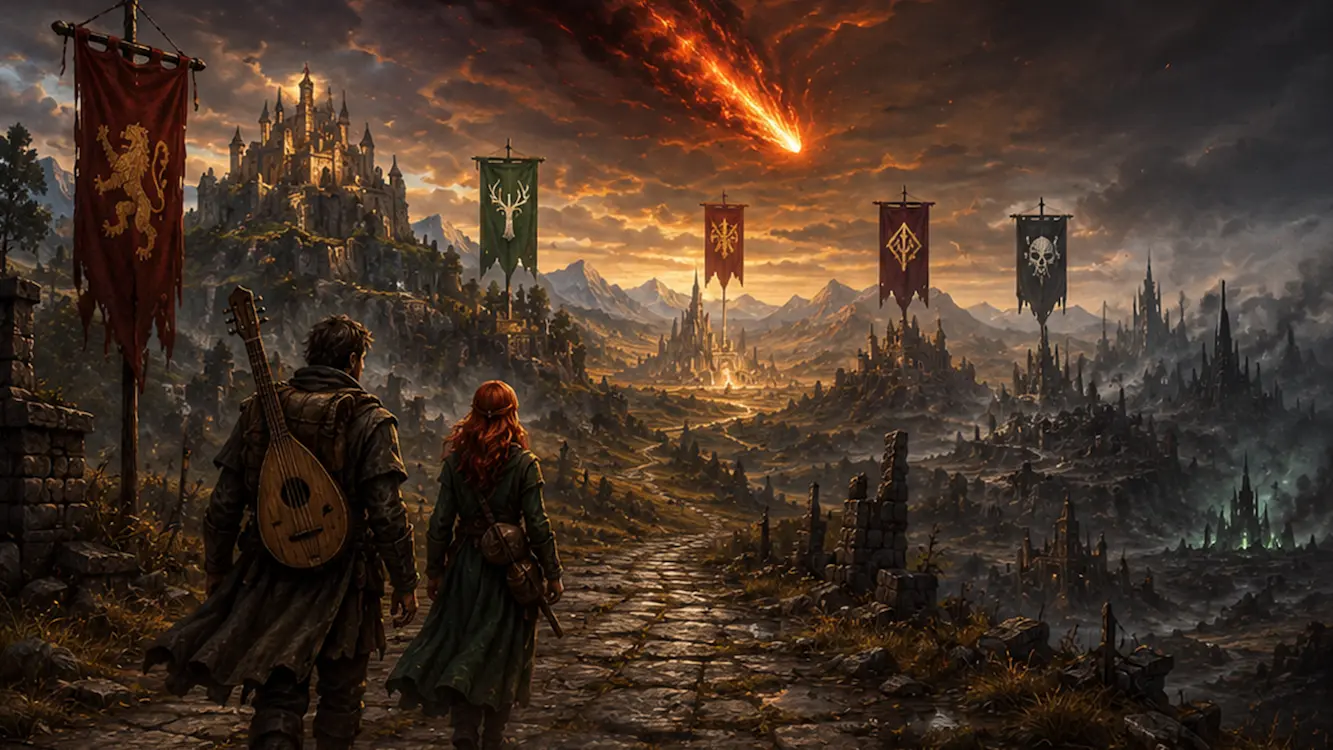
There are roads in Thaloria that no cart will take now.
I know, because I have walked them.
I have walked the old king’s road west of Ironhaven, where grass grows through cracked stone and the wind pulls at torn red banners like a beggar tugging at a sleeve. I have crossed the root-choked paths of Mistwild, where the trees lean too close and whisper names that are not yours. I have climbed the broken passes beneath Runegrim and heard hammers ringing in the dark long after the forges should have gone cold.
I have seen Shadowspire burning from within.
I have heard the bells of Cryptgard toll beneath the earth.
So when men ask me for a song of Thaloria, I do not begin with glory.
Glory is what kings ask for after the killing is done.
I begin with the road.
My name is Simon. Some call me Simon of the Road, though that sounds grander than it is. I have owned no hall, held no land, commanded no warriors, and worn no crown. I carried a lute, a pack, a knife too small for war, and a tongue quick enough to keep my head on my shoulders more often than not.
In the Gentle Age, that was enough.
A man could walk from Ironhaven to Mistwild with silver in his pouch and a song in his throat. He could drink dwarven ale beneath Runegrim, lose half his coin at a goblin dice table in Shadowspire, and still find a bed in a roadside inn before the moon rose. Even near Cryptgard, where the mists crawled low and sensible folk barred their doors at dusk, the roads held.
The roads mattered.
Roads are promises. They say a place can be reached. They say a traveller may leave home and come back again. They say the world, for all its teeth and weather, still allows passage.
When the roads failed, we should have known the realm had failed with them.
But people are slow to see the end of things. A cracked wall is only a cracked wall until the roof comes down. A bad harvest is only a bad harvest until the granaries empty. A king’s anger is only a king’s anger until the banners rise.
And the banners did rise.
Red and gold for Ironhaven. Green and silver for Mistwild. Deep red for Runegrim. Brown and black for Shadowspire. Dark grey for Cryptgard.
They rose over farms. Over bridges. Over wells. Over burial fields where the dead had not yet been named.
Men cheered them at first. That is the shame of it.
We were frightened, and frightened people love a banner. A banner tells them someone is in command.
It does not tell them whether that someone should be.
Before the war, Thaloria was held by five great powers.
Ironhaven was the human kingdom, broad of field and proud of wall. Its people were farmers, soldiers, masons, horse-breeders, smiths, bakers, wives, husbands, thieves, priests, and fools, which is to say they were much like people anywhere. They loved their king because King Alaric Stormforge loved order, and in those days order felt like kindness.
Mistwild belonged to the elves, though the elves would have said they belonged to Mistwild. Their halls were grown more than built, shaped from living wood and silver stone. They remembered every oath, every insult, every song, and every death. King Thalorien Evermist ruled there with a calm face and eyes that always seemed to be looking at something behind you.
Runegrim was carved into the mountains. The dwarfs filled it with fire, iron, music, and arguments loud enough to shake frost from the peaks. King Haldrek Flamebeard could laugh like a rockslide and stand like a gate. His people believed nothing worth making should be made lightly.
Shadowspire rose from black stone and smoke. The goblins kept its stairs, tunnels, ledgers, traps, markets, secrets, and blades. Do not let drunk soldiers tell you goblins are weak because they are small. A small knife still opens a throat. King Zarkul Grimhex knew this better than anyone.
And then there was Cryptgard.
The skeletons held the marshlands and the old grave roads. Their king, Azmorth Grimshroud, was not like other rulers. He did not feast. He did not age. He did not sleep. He studied death with the patience of a scholar and the pride of a king who believed every locked door was an insult.
Those were the five crowns of Thaloria.
They were not friends, no matter what the old songs claim. They bargained, threatened, smiled, and lied, as rulers do. But they kept the Concord of the Sacred Grotto.
That mattered more than friendship.
The Sacred Grotto stood at the heart of the realm, where the old maps met and the ancient roads bent inward. No army marched there. No blood was to be spilled upon its golden soil. Kings came to speak. Pilgrims came to kneel. Sick men came hoping for healing. Children came to see the marble altar and throw petals into the clear spring that ran beneath it.
I played there once, before the star fell.
Edda was with me then.
You will hear her name often, if you have patience enough to listen. Edda carried a fiddle, a sharper knife than mine, and a habit of telling the truth when silence would have been safer. She had red hair, quick hands, and a temper that could strike sparks from wet wood.
She said I lied too easily.
I said she made honesty look painful.
We were both right.
We came to the Grotto in the last summer of the Gentle Age. The five kings were gathering there, and where kings gather, musicians eat. That was my wisdom in those days. Follow weddings, councils, funerals, and wars, because people at such events are either too happy, too proud, too drunk, or too afraid to count their coins properly.
I did not know I was walking toward the wound of the world.
None of us knew.
There were omens, of course. There are always omens once men know where to look. A calf born with golden eyes. A river that ran warm for three nights. A mirror in Ironhaven that cracked without being touched. Elven children dreaming of black glass under green roots. Dwarven furnaces flaring white. Goblin lanterns burning blue. Bells ringing beneath Cryptgard when no hand pulled the rope.
Small things.
Small enough to ignore.
The star made itself harder to ignore.
It came at night.
Not falling. Not at first.
Watching.
A bright wound in the sky, too large for a star and too still for a comet. For seven nights it hung above Thaloria. On the eighth, it moved.
I saw it split the heavens.
Clouds burned gold from within. Shadows ran ahead of the light. Horses screamed. Kings shouted. Priests prayed. Edda cursed with such force that even the elves looked offended.
Then the star struck the Sacred Grotto.
The world did not end.
That would have been simpler.
The ground rose like a wave. Trees bent flat. The marble altar burst into white dust. The spring boiled. The grass turned to true gold in the space of a breath, every blade shining hard and bright beneath the fire.
Where the altar had stood, there was a crater ringed in black glass.
And in the centre of that crater lay the star.
It did not look dead.
That was the first true fear I felt. Not the shaking ground. Not the heat. Not the blood running from my ears.
It was the stone.
It pulsed softly, like a heart.
The kings came to it.
Of course they did.
Kings always come to power. Some come with prayers. Some with armies. Some with open hands and honest intentions.
But they come.
Azmorth touched it first.
I have wondered for years whether things would have gone differently if another hand had reached the star before his. I have asked priests, scholars, witches, drunks, and one dying goblin who claimed to know the name of the moon’s mother.
None gave me an answer worth keeping.
Azmorth touched the star, and his eyes filled with white fire.
After that, the others followed.
Alaric.
Thalorien.
Haldrek.
Zarkul.
Five kings. Five crowns. Five hands upon a thing that had fallen from beyond the world.
People say the star corrupted them.
That is true, but not complete.
The star did not plant new hungers in the kings. It fed the hungers already there.
Alaric wanted to protect his people. The star taught him that protection and possession were close enough to share a name.
Thalorien wanted to preserve what was beautiful. The star taught him that nothing is safer than what cannot move.
Haldrek wanted to build something that would outlast death. The star taught him that any fire was acceptable if the forge was great enough.
Zarkul wanted his people to be feared. The star taught him that fear could be sharpened into law.
Azmorth wanted to defeat death. The star taught him that the dead are easiest to command.
That was how the kings fell.
Not all at once. Stories make things neat because neat things are easier to remember. Truth is messier. The kings did not grow horns beneath the moon or begin laughing over cups of blood. They returned to their kingdoms with calm faces and new purposes. They spoke of safety, memory, strength, freedom, and mercy.
Good words.
The most dangerous words usually are.
Then the banners rose.
Then the roads closed.
Then the Dungeons opened.
You have heard of the Dungeons, I suppose. Children dare each other to touch their doors. Soldiers spit before saying their names. Wizards pretend to understand them.
Fools.
The Dungeons are not only caves, nor prisons, nor tunnels beneath the earth. They are places where the world forgot its proper shape after the star struck. A man can step through a hidden door beneath Runegrim and hear the bells of Cryptgard. A warrior can vanish from a battlefield at noon and return two days later with frost in his beard and no memory of his own name.
Some do not return at all.
Those are the lucky ones, depending on who is telling the tale.
I saw enough to know this: after the star fell, Thaloria was no longer one realm. It became a board of broken lands, each tile claimed, contested, cursed, or abandoned. Armies moved from field to bridge, from bridge to hill, from hill to shrine. Wizards held warriors in reserve like knives hidden under a cloak. Relics were dragged from ruins. Spells split the sky. Banners marked the ground, and the ground remembered.
But that came later.
This story begins before all that.
It begins when roads still held, when kings still smiled, when the Grotto still shone with peace, and when I was still fool enough to think a song could earn supper and nothing more.
I was wrong about many things.
I was wrong about kings.
I was wrong about monsters.
I was wrong about the difference between a curse and a gift.
But I was not wrong about the road.
The road remembers.
So I will tell it as the road gave it to me: stone by stone, mile by mile, blood by blood.
Listen well.
This is the story of Thaloria before the Rebellion, before the sea rose in fury, before strangers came hungry for our land and magic.
This is the story of the five crowns.
This is the story of the fallen star.
This is the story of when the kings fell.
Next Chapter